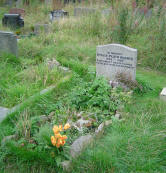
| Sylvia Plath is buried in St.Thomas' Churchyard, Heptonstall, West
Yorkshire, England. (Her epitaph comes from the
Bhagavad-Gita.)
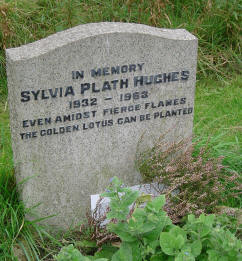
Gravestone of Sylvia Plath
Photographs by Tim Simpson
Her grave bears the name 'Sylvia Plath Hughes' as she was married to fellow poet Ted
Hughes. The pair met in 1956 when Plath studied at Newnham College Cambridge on a
Fulbright scholarship from the United States. They married in the same
year. Her first collection The Colossus appeared in 1960 and
her only novel The Bell Jar in 1963.
After a spell teaching in the US the couple returned to England -
living first in London and then at North Tawton in Devon. When they
separated Plath moved back to London and rented a flat that had once
been the home of W.B. Yeats. It was here that
she committed suicide on the 11th of February, 1963 by gassing herself. She
was 30 years old. Before killing herself, Plath left
food and drink out for her children Nicholas and Frieda, and made sure they were
safe in their bedrooms. She had previously made two suicide attempts and
bore a scar on her cheek as proof. Plath's famous collection Ariel was published two years after her
death and contained many of her well known poems such as: Lady Lazarus,
Daddy, The Bee Meeting and Tulips. It was edited by Ted
Hughes. Her two other collections: Crossing the Water and
Winter Trees were also published after her death and edited by
Hughes. Despite the circumstances of their separation, Hughes was always
keen to see that Plath's work was available to the world. It also proved
to be a major commercial success.
Plath frequently wrote about child birth, hospitals and suicide
and employed disturbing and distorted imagery. Her work has often been
compared to that of Anne Sexton. Larkin called
her the 'Horror Poet'.
Ted Hughes left Sylvia Plath for Assia Wevill with whom he had a
daughter Shura. Tragically Assia also committed suicide and killed their
daughter too in the same manner as Sylvia Plath. Hughes dedicated Crow
- his bleak 1972 collection to them.
Plath's relationship with Ted Hughes was the subject of the 2003
feature film entitled Ted and Sylvia which starred Gwyneth Paltrow
and Daniel Craig.
|